Choosing to become a pilot isn’t just a career decision—it’s a life decision. At Sha-Shib Flying Academy (SFA), located at Guna Airport, we help you transform your passion for aviation into a confident, future-ready profession.
Whether you dream of flying for a leading airline or enjoying the freedom of flying your own aircraft, your journey begins here.
Best suited for:
Entrepreneurs, business leaders, aviation enthusiasts and hobby flyers.
Important to know:
PPL is strictly for non-commercial flying and cannot be used for paid operations.
Eligibility
Best suited for:
Students aspiring for a high-growth, high-respect aviation career.
Career Outlook:
India is projected to require 19,400–22,400 pilots by 2030,
making this one of the most future-secure professions today.
Eligibility
Airlines like Air India and IndiGo have placed massive aircraft orders.
Every aircraft requires multiple pilotsdemand rises with every delivery.
A large number of senior pilots are nearing retirement, creating vacancies at First Officer and Captain levels.
According to CAPA India:
For students entering training today, the future is exceptionally strong.
Indian pilots are among the most respected worldwide. Due to a global pilot shortage, international airlines actively recruit Indian-trained pilots for their strong regulatory and training standards- opening doors to global careers and international exposure.
India is a global leader in women pilots, with over 12% female representation, far above the global average- proving aviation is open, inclusive and future-focused.
Modern aircraft are more fuel-efficient and eco-friendly. Pilots trained on advanced avionics and modern systems will lead the transition toward sustainable aviation.
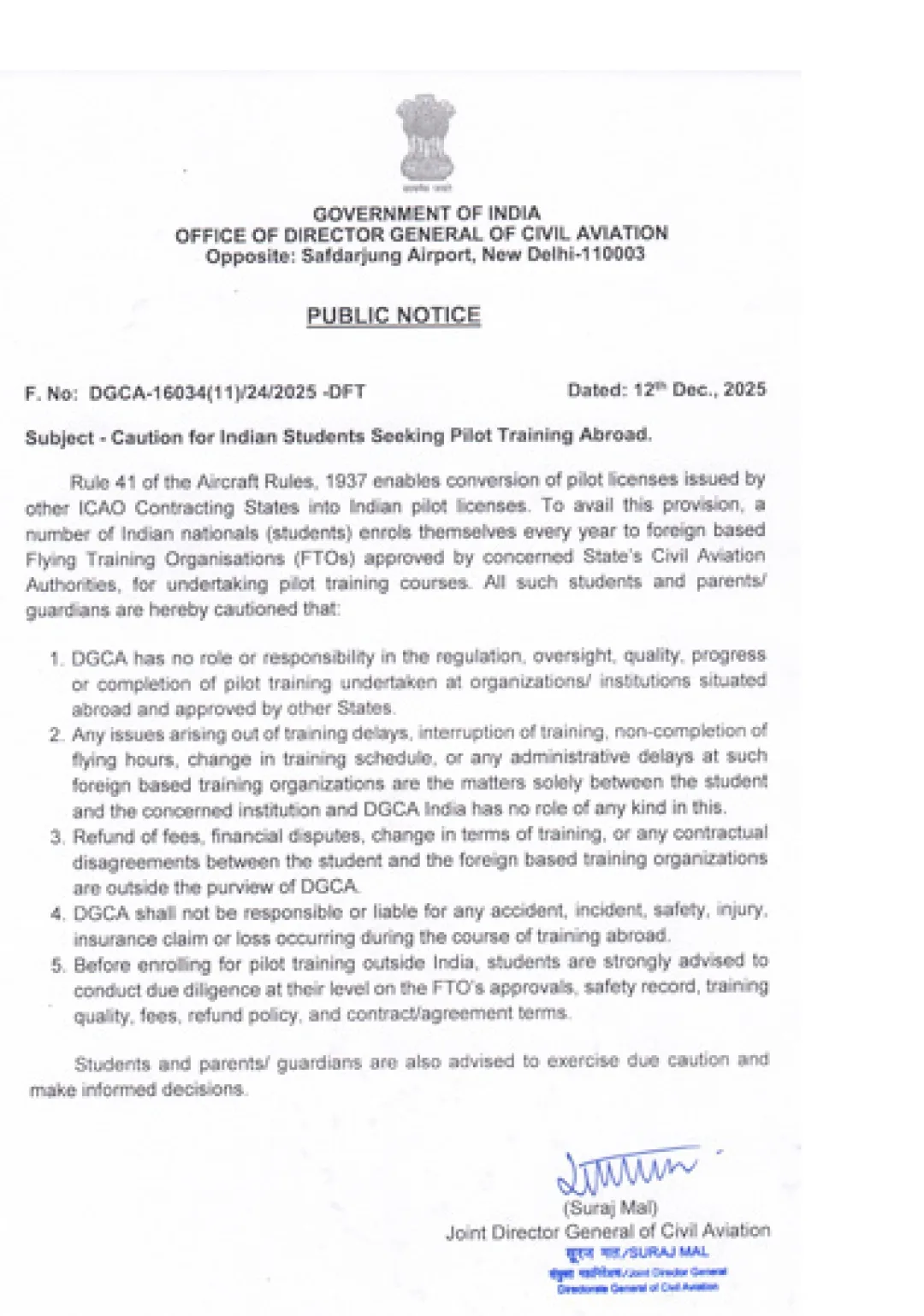
As per Public Notice F. No.: DGCA-10034(11)/24/2025-DFT dated 12 December 2025, issued by the Directorate General of Civil Aviation (DGCA), Indian students intending to undergo pilot training abroad are cautioned that DGCA does not regulat supervise, or bear any responsibility for foreign Flying Traininç Organisations (FTOs) approved by other States. DGCA shall have no role or liability in matters related to training quality, delays, interruption or non-completion of flying hours, changes in training schedules, fee refunds, financial or contractual disputes, safety, accidents, insurance claims or any loss arising during the course of training abroad. All such issues remain solely between the student and the concerned foreign institution. Students and parents/guardian are therefore strongly advised to exercise due diligence and to take informed and cautious decisions before enrolling for pilot training outside India.
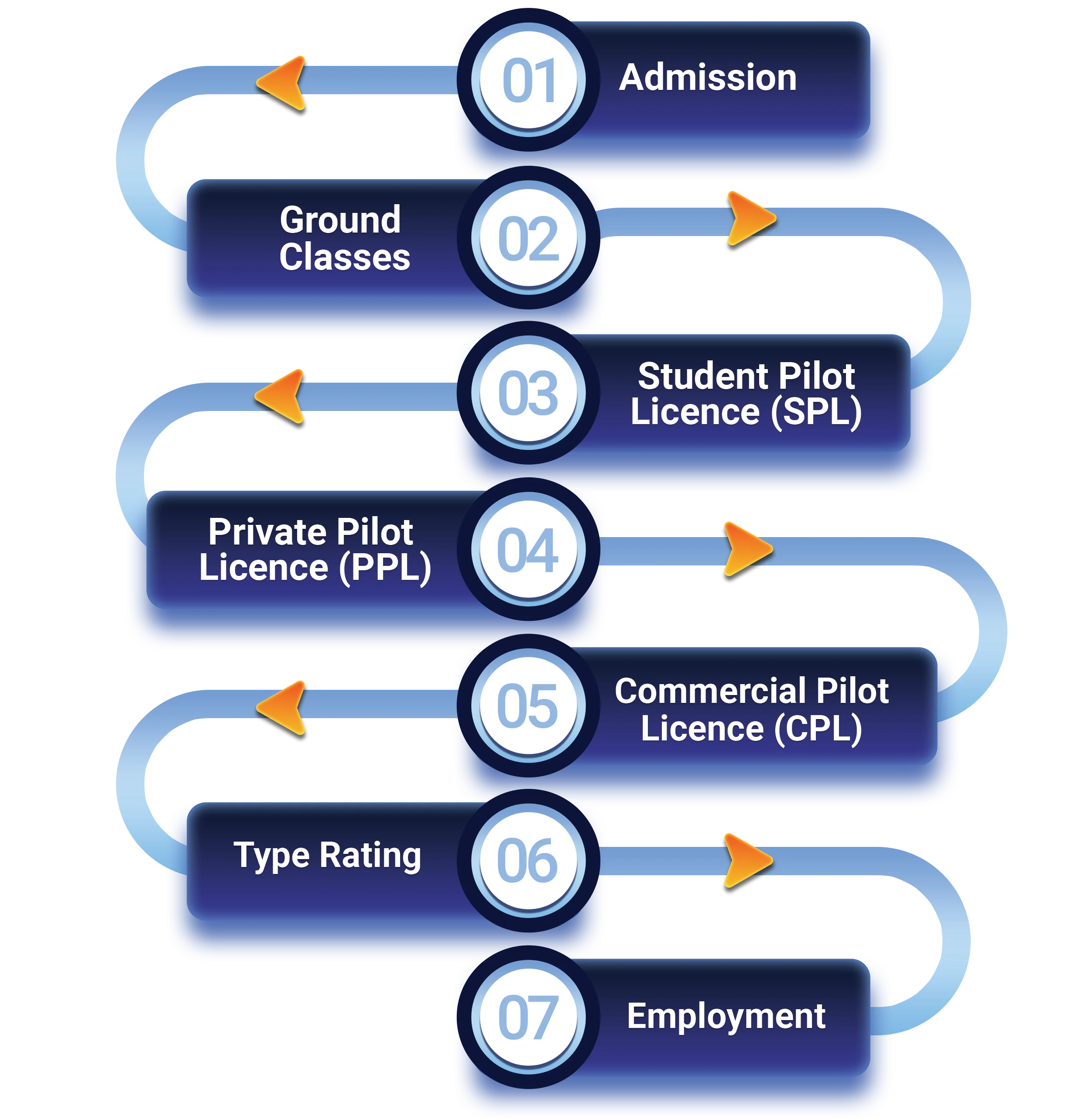
Your Journey Begins Here
CPL (Eligibility: 18+, 10+2 РСМ, 200 hrs of Flying + DGCA Class I Medical)
AFI - Assistant Flying Instructor (Eligibility: CPL+20 hrs patter Flying experience)
FI/ FTI-Flying Instructor / Flying Training Instructor
(Eligibility: CPL + 200 Hrs PIC or 500 hrs total flying)
DY. CFI - Deputy Chief Flight Instructor
(Eligibility: Experienced with 1000 hrs PIC, 600 Hours Instructional + leadership skills)
CFI/ Chief Instructor
(Eligibility: –2,200 hrs total flying in which 1800 hrs PIC & 1200 instructional DGCA approval)
CPL (age 18+, 10+2 РCM, 200 hrs of Flying + DGCA Class I Medical)
Co-Pilot / First Officer (CPL + minimum PIC hours as per operator & DGCA)
Pilot in Command (PIC) (CPL+500-1,500+ hrs total flying + DGCA PIC rating)
Check Pilot (Extensive PIC experience + DGCA approval)
CPL (18+, 10+2 РСМ, 200 hrs flying + DGCA Class I Medical)
First Crew / Junior Pilot (CPL + airline selection + simulator / aptitude test)
Co-Pilot/ First Officer (CPL + minimum PIC hours per DGCA & airline policy)
Pilot in Command / Captain (Min. 1,500–2,000+ hrs total flying + DGCA PIC approval)
Check Pilot (Extensive PIC experience + DGCA check pilot approval)
The SPL is your entry permit to flight training. Issued by the DGCA through a DGCA-approved Flying Training Organisation like Sha-Shib Flying Academy, it allows you to begin flying under the guidance and supervision of a certified instructor.
Air Regulations: Covers Indian and international aviation laws, ICAO Annexes, rules of the air and licensing requirements.
Air Navigation: Involves flight planning, meteorology, chart reading, time calculations, radio aids (VOR, DME, ADF) and instruments.
Aviation Meteorology: Focuses on weather reports (METAR, TAF), clouds, pressure systems and their impact on flight safety.
Technical General (Aircraft & Engines): Covers aircraft systems, aerodynamics, piston/jet engines and instrumentation.
Technical Specific: Examines specific aircraft systems and performance parameters.
Radio Telephony Restricted (Aeromobile) - RTR(A): A crucial practical/written exam conducted for communication procedures.
You begin practical training and work toward a Private Pilot Licence (PPL). This phase builds your basic flying skills and confidence. You learn navigation, communication and aircraft handling.
You must complete around 200 flight hours (as per current DGCA regulations), clear DGCA written exams in Air Regulations, Air Navigation, Aviation Meteorology, Aircraft Technical, and RTR (Radio Telephony), and hold a valid Class I Medical Certificate. Once you meet these requirements, you become legally eligible to work as a paid commercial pilot.
This stage turns your dream into a licensed profession
Pilot training doesn't lead to one job, it opens a lifetime aviation career ladder
Type-rating + CPL = entry into airlines as a Co-Pilot on commercial aircraft.
With 1500+ flight hours, clear ATPL requirements, simulator checks and airline assessments to become Captain.
Work Abroad via DGCA licence conversion (FAA/ EASA) Flight Instructor Path: AFI » FI/FTI→Dy. CFI→Chief Flight Instructor Ground Instructor Roles in DGCA theory subjects